The Diary.

Litter updates, show recaps, and everything I’ve picked up raising Holland Lops — written as it happens, not polished after the fact.

Litter Updates

Care Tips

Show Recaps

Behind the Scenes

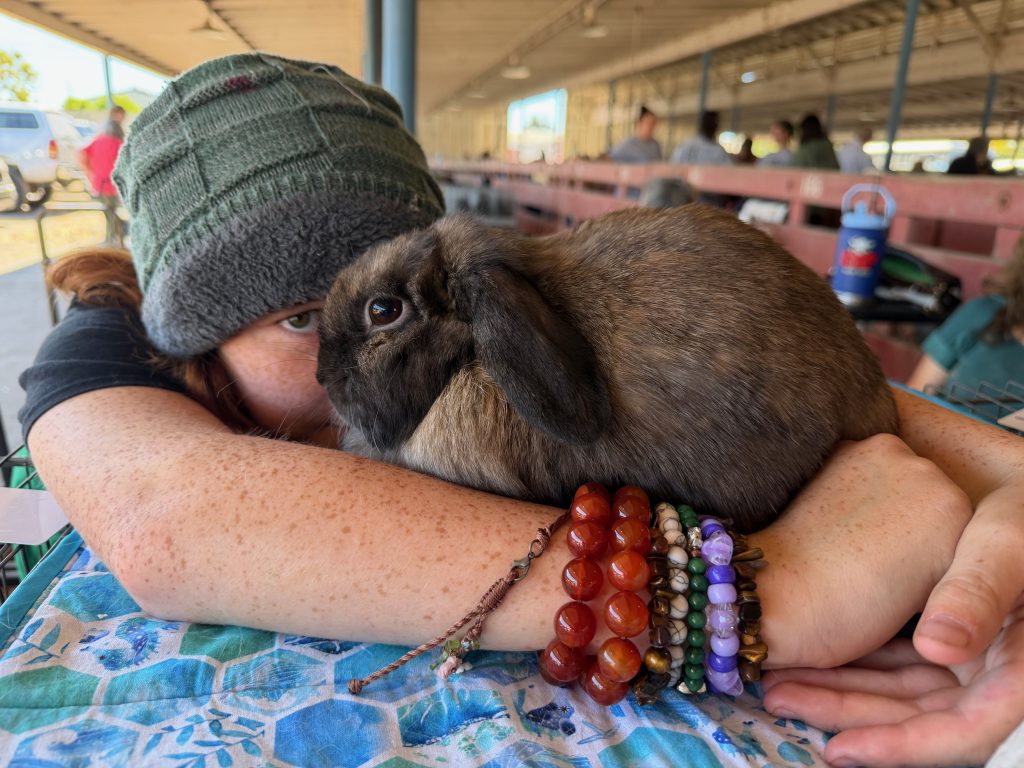
At the Monterey show in 2026. Elliot with Moxie who is an unrecognized color.

Elliot with Moxie at the Monterey show, 2026

Latest Entry · Aug 17, 2026

Everything We Wish We Knew on Day One

Hollands are hard. Here’s what we’ve learned about culling, craft, and playing the long game. — By Cynthia

Hollands are hard.

They’re incredibly cute, with personalities that range anywhere from psychotic boxer to labrador retriever. They’re small and easy to handle — they won’t throw out your back when you lift them out of a cage the way a Rex might. But breeding them to type, when you’re developing your own line, is another story entirely.

Statistically, half of what you produce will be peanuts or Normals. Throw in a fuzzy or two, an unrecognized color, and a couple of DQs, and suddenly your 5 litters and 16 babies is down to four show possibilities. Of those four, maybe one — if you’re lucky, two — will actually be good enough to want to use in your program.

And you still have to keep breeding. So what do you do with the babies and rabbits that aren’t useful to your program? There’s a degree of ruthlessness you have to embrace to perfect your line. You can’t get attached to every rabbit — not when your barn only has 30 cages. And sometimes, if a line just isn’t working, you have to pull it from your barn and start over.

I recently read a post by Cody Taylor that resonated deeply with me about the art of breeding. He talked about the craft — how it isn’t something you can buy, only learn and feel, through years of practice, training your eye, and building something slowly. It’s about becoming so fully immersed in the genetics that intuition takes over, letting you create truly great pairings.

But to get there — to train the eye, to build the intuition — you have to be ruthless first, and cull the low-hanging fruit. That’s where we are now, and it’s not something we fully understood when we jumped into this with our whole hearts.

Hollands are hard, and this adventure is a marathon, not a sprint. No matter how much quality you invest in at the beginning, genetics don’t always cooperate — and sometimes the hardest part of this hobby is letting go of an animal you love because it’s the right call, not the easy one.

New entries land here first — before Instagram.